
Adi Shankara’s Systematic Commentary on the Ten Principal Upanishads
The Upanishad Series

The sacred texts known as the Upanishads represent the foundational wisdom of Hindu philosophy, collectively forming the Vedanta, or the end/goal of the Vedas. They are considered Shrutis—revealed thoughts—and are accorded the exclusive privilege of possessing svatapramanya (the unquestionable right to be the authority by themselves). Among the over one hundred texts, ten are universally recognized as the principal or Mukhya Upanishads: the Isa, Kena, Katha, Prasna, Mundaka, Mandukya, Taittiriya, Aitareya, Chandogya, and Brihadaranyaka.
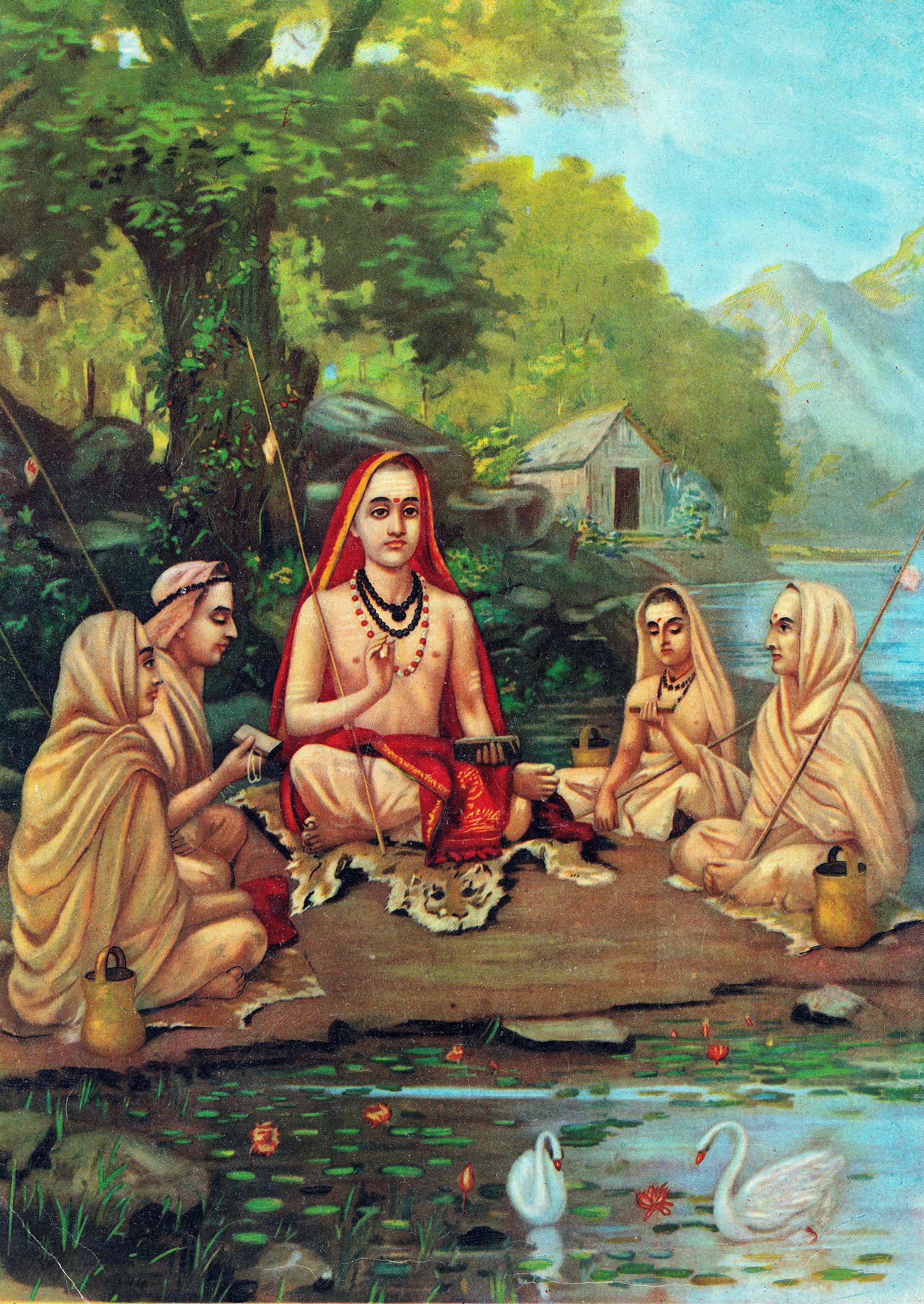
Adi Shankaracharya (c. 688 CE - 720 CE), the first and greatest Advaita thinker, solidified the canonical authority of these ten texts by composing systematic and exhaustive commentaries, known as Bhashyas, upon them. Shankara’s commentaries, which are part of his Prasthanatrayi Bhashyas (covering the Upanishads, the Brahma Sutras, and the Bhagavad Gita), reveal his relentless logic, subtle reasoning, and terse expression, and are dedicated wholly to establishing the doctrine of Advaita Vedanta (Non-Dualism).
The Foundational Philosophy of Shankara’s Advaita
Shankara’s philosophy postulates that the ultimate reality, Brahman, and the individual soul, Atman, are fundamentally identical, a concept summarized in his renowned half-verse: “Brahman satyam; jagan mithya; jivo brahmaiva naparah” (Brahman is real. The world is illusory (not the ultimate reality). The jiva is non-different from Brahman).
The Nature of Brahman and Maya
Brahman is the nondual, formless, unqualified (Nirguna) Reality when viewed in itself, transcendent and beyond all instruments of thought. The Taittiriya Upanishad, interpreted by Shankara, provides the definitive Swarūpa Lakshanam (direct definition) of Brahman as “Satyam, jnanam, anantam Brahman” (Reality, Knowledge, and Infinity).
The perceived diversity of the universe (Jagat) is explained by Shankara through the concept of Maya, which is the complex, illusory power of Brahman. Maya is beginningless (anādhi) and compound of the three gunas, yet it is temporary and is transcended with true knowledge. It functions by hiding Brahman and presenting the material world in its place. The world, though illusory from the standpoint of the Ultimate Reality, is essential in the pragmatic realm, where the Supreme Lord (Ishvara) uses Maya to act as the all-perfect, omniscient creator, sustainer, and destroyer of the world.
The Path of Knowledge (Jñāna Mārga)
Shankara firmly maintains that Absolute Liberation (Kaivalya-mukti) is attainable only through knowledge (Jnana). Knowledge is the necessary and sufficient means to achieve Moksha. The core purpose of the Upanishads is to make the aspirant realize his true nature of being Brahman and become liberated.
Shankara rejects the notion that liberation is achieved through a combination of knowledge and ritualistic action (Karma-kanda). Rituals and works (Karma) belong to the sphere of Avidya (nescience) and rely on the notion of “I am the doer” (kartā), which is destroyed when the Self’s true nature as actionless (akartā) consciousness is realized. Karma serves only an auxiliary function—to purify the inner equipment (anta-karana nairmalya) and prepare the seeker for knowledge. The acquisition of knowledge involves intense study (śravaṇam), reflection (mananam), and deep absorption (nidhidhyāsanam).
Specific Contributions of the Ten Principal Upanishads
Shankara’s commentaries systematically draw out the Advaitic teaching from each principal Upanishad, demonstrating that the identity of Brahman and Atman is the sole purport of all these texts.
1. Brihadaranyaka Upanishad
The Brihadaranyaka is considered the greatest of the Upanishads in both extent and substance, and Shankara’s Bhashya on it is regarded as the greatest of his commentaries on the Upanishads.
Brahman’s Nature and Identity: The text reveals the illimitable, absolute Brahman, identical with Atman. It employs powerful dialectical modes of argumentation (jalpa and vāda) to establish the Brahman-Atman identity.
Neti, Neti: The Brihadaranyaka introduces the negative description of Brahman as “Not thus, not thus” (Neti, neti), signifying that Brahman is beyond finite descriptions.
Structure and Content: The Upanishad is divided into three Kandas: Madhu-kanda (conveying the Advaita teaching), Yajnavalkya-kanda (providing the logical argument), and Khila-kanda (dealing with meditation). It outlines the doctrine of the two forms of Brahman (the formed, gross, mortal and the formless, subtle, immortal). It asserts that the husband is dear, not for the husband’s sake, but for the Self’s sake. It affirms that if Brahman is known, nothing else is needed to be known, because there exists nothing else apart from the Self.
Chandogya Upanishad
The Chandogya is an ancient source of Vedantic fundamentals.
Mahavakya: It is the source of the Mahavakya “Tat Tvam Asi” (That thou art), asserting the absolute equality of the individual self and the Universal Reality. Shankara’s interpretation of Tat Tvam Asi emphasizes that this undivided consciousness alone has been revealed.
Brahman as Existence: The text establishes Brahman as Existence, One only, without a second. Shankara notes that the liberated one realizes Ātma as akashatma—one whose nature is like that of space, all pervasive, subtle, and free from form.
The Pursuit of the Infinite (Bhuma): The Upanishad states that the Infinite (Bhuma) is immortal, while the finite is mortal, and the Infinite is the Self.
3. Taittiriya Upanishad
The Taittiriya is regarded as a sourcebook of Vedanta philosophy.
Svarūpa Lakshanam: It contains the formula “Satyam, jnanam, anantam Brahman” (Brahman is Reality, Knowledge, and Infinity), a key definition used by Advaita to establish the true nature of Brahman.
Creation and Entry: The Upanishad details the creation process, where Brahman, desiring to become many, created all things and entered into everything, becoming both sentient (sat) and insentient (tyath). This emphasizes Brahman as both the material and efficient cause.
Meditation on Om: The text emphasizes that Om is Brahman and that one who meditates on Om attains to Brahman.
4. Mandukya Upanishad
The Mandukya is the shortest of the principal Upanishads.
Sufficiency for Liberation: The Muktika Upanishad asserts that the Mandukya Upanishad alone is enough for salvation.
Om and Turiya: The entire Mandukya Upanishad is dedicated to an explanation of the syllable Om, proclaiming it to be the imperishable Brahman and the universe. It analyses the three states of consciousness (waking, dreaming, deep sleep) and the fourth state, Turiya. Turiya is described as the negation of all phenomena, Peace, Bliss, and the One without a second.
Shankara’s Unique Commentary: Shankara’s Bhashya on the Mandukya is unique because he interpreted not only the twelve mantras but also the exhaustive Karika (explanatory verses) composed by his teacher’s teacher, Sri Gaudapada.
5. Katha Upanishad
The Katha Upanishad is known for its allegories and profound influence on the Gita.
Nature of the Self: The text declares that the Self is soundless, touchless, formless, undecaying. The Self of the nature of consciousness is not born; It does not perish.
Jnana vs. Karma: Shankara utilizes the Katha Upanishad to stress that the attainment of the Eternal is not by works.
Simile of the Bow and Arrow: It provides the spiritual analogy that Om is the bow; the Self, purified by Upasana, is the arrow; and Brahman is said to be its target.
6. Aitareya Upanishad
The Aitareya is associated with the Rig-Veda.
Mahavakya: It contains the Mahavakya “Prajñanam Brahma” (Consciousness is Brahman).
The Self as Pure Consciousness: The text emphasizes that various faculties—such as the heart, mind, and senses—are merely adjuncts of the Self, who is pure consciousness. It asserts that the reality behind all beings, born of eggs, womb, heat, or soil, is Brahman, who is pure consciousness. The Self is the ultimate subject (Sākshi), which none of the outwardly turned sense organs can reveal.
7. Mundaka Upanishad
The Mundaka is highly important for the Jnana Marga (Path of Knowledge).
Two Knowledges: It divides knowledge into Para Vidya (higher knowledge, leading to the Changeless Reality) and Apara Vidya (lower knowledge, dealing with the material world).
Creation Simile: The Upanishad uses the spectacular simile that all things arise from the depths of the Imperishable (Brahman) like sparks innumerable fly upward from a blazing fire, and they return to It.
Monasticism and Renunciation: It lauds Sarva Karma Sannyasa (renouncement of all action) as essential for attaining the knowledge of the supreme reality, stating that action does not make the illusion of the world disappear. It contains the metaphor of the two birds (individual self and immortal Self) on the same tree, perpetually united (sayuja).
8. Kena Upanishad
The Kena is one of the earlier, primary Upanishads.
Transcendence of Brahman: The text deals with the indescribable nature of Supreme Brahman. It repeatedly asserts that Brahman is not that which the eye can see... but that whereby the eye can see. Brahman is the source of the senses’ power.
Shankara’s Commentaries: Shankara wrote two commentaries on the Kena: the Padabhāṣya and the Vākyabhāṣya. In his commentary on the third khanda, Shankara equates Atman-Brahman with Ishvara-Parameshvara.
Ethical Foundation: The Upanishad asserts that Tapas (austerity/meditation), Damah (self-control), and Karma(work) are the foundations for self-knowledge and Atman-Brahman realization.
9. Isa Upanishad
The Isa Upanishad is listed first among the principal texts.
Non-Duality: The Upanishad asserts that whoever sees all beings in the soul and the soul in all beings has no delusion or sorrow.
Renunciation: Shankara begins his commentary by establishing that the mantras are meant to teach the true nature of the Self. The essence is the realization that all belongs to the One. The perception of the unity of the Self is a settled fact of the Upanishads. Shankara’s interpretation here deals with the incompatibility of knowledge and action.
10. Prasna Upanishad
The Prasna Upanishad is associated with the Atharva-Veda.
Structure: It is structured as a series of questions (Prashnas) and answers designed to lead the student to the knowledge of Brahman.
Ultimate Source: The text asserts that the ultimate supreme source of all existence is Brahman. The Upanishad also discusses Prana (vital air) as the essence that underlies all movable and immovable beings.
Purvapaksha and Siddhanta Dialogues
One of the principal challenges Shankara faced was the Mimamsa school of thought, which was the main opponent in his works. The Mimamsa system established strict ritualism and maintained that the aim of the Veda is to prescribe certain ritualistic actions (karma), asserting that release is gained through action alone. Shankara countered this by arguing that Vedic rituals and works are secondary pursuits. He repeatedly emphasized that Karma only serves a preparatory role by purifying the mind (cittaśuddhi), but cannot lead directly to Moksha.
A specific manifestation of this opposition was the doctrine of Jñāna-Karma Samuccaya Vāda, a popular philosophy asserting that knowledge must be combined (samuccaya) with action (Vedic rituals, or vaidika karma) to achieve liberation. Shankara relentlessly refuted this combination, establishing that liberation comes from kēvala jñānam (knowledge alone). His critique centered on the intrinsic contradiction between knowledge and action: true knowledge (Jnana) requires the attitude of akartā (non-doer), while the performance of Karma requires the attitude of kartā (doer). Therefore, they cannot be simultaneously combined by a single seeker.
Shankara also directed his arguments against non-Vedantic schools, notably Buddhism. Although his Advaita philosophy shared similarities with Mahayana Buddhism, particularly regarding non-dualistic ideals and the theory of Maya, Shankara sharply distinguished his teachings from the Buddhist schools. The key difference he established was that Advaita Vedanta firmly believes in the existence of the Atman (Self), a concept entirely absent in Buddhism. Furthermore, while opponents accused him of being a “crypto-Buddhist” due to his radical non-dualism, Shankara clarified that his concept of Maya (illusion of the world) arises from the premise that Brahman alone is real, contrasting with Buddhist doctrines of emptiness.
In addition to these major challenges, Shankara’s polemics targeted other philosophical systems, including Sankhya and Yoga. He argued that liberation cannot be achieved through the practices of Yoga, advocating for pure wisdom-understanding. Similarly, he critiqued Sankhya because it posits a difference between jīva and jagat, functioning fundamentally as a dualistic system (dvaita śāstram) which cannot lead to true non-dual liberation. Shankara argued that while Yoga practices might be preparatory or helpful, they cannot lead directly to Moksha. The mind in samādhi may be merely “quietly-ignorant”, and thus Yoga practices cannot “produce the transformative knowledge” needed for freedom. He advocated instead for wisdom-understanding over disciplines like Pranayama, which he considered “not conducive to the attainment of the Absolute”. He contended that liberation is achieved only through pure wisdom-understanding (kēvala jñānam). Shankara argued that quietude is not the same as Self-knowledge.
Therefore, for Shankara, the means of Moksha remained steadfastly Self-knowledge, with Yoga serving merely as a preparatory aid—a tool for mental purification and self-control, necessary to make the system fit to receive the liberating philosophical teaching.
The Legacy of the Bhashyas
Adi Shankaracharya’s commentaries on the ten principal Upanishads are far more than mere linguistic expositions; they are an encyclopedia of the ancient Purusha. By establishing the consistent, unified doctrine of non-dualism (Advaita)across these foundational texts, Shankara proved that the Upanishads provide the royal path to the final release from bondage. He taught that realization is a flash of understanding which replaces the mistaken belief of duality (Adhyasa) with the correct one. The intensive study (Vichāra) of the Upanishads, aided by the Guru, leads to the dissolution of accumulated Karmas and the realization of the changeless, eternal, actionless Self. The ultimate goal is Kaivalya-mukti, attained when the three kinds of bodies (gross, subtle, and causal) are abandoned, and the Jiva rises to the level of fullness (Videha-mukti), achieving absolute liberation.