
Business Plan to Business Alignment
Beyond SWOT: How to Deepen Your Strategic Dialogue Using the Business Aligner

If you have ever sat through an annual strategic planning meeting, you know the drill: executives gather, a SWOT analysis is drawn up, and a static business plan is produced to solve the immediate problems of the day. Yet, time and again, these strategic meetings fail to create lasting transformation because they are treated as one-off events rather than an ongoing dialogue.
In today’s volatile, uncertain, complex, and ambiguous (VUCA) world, traditional tools like SWOT and TOWS often fall short. They are static, simplistic, and tend to result in fragmented analyses that detachedly look at the environment without synthesizing a true “vision of direction”.
If you want to move your organization from default futures to designed futures, you need a different framework. Enter the Business Aligner (BA).
What is the Business Aligner?
Developed at TAO Consulting, the Business Aligner is a holistic, systems-thinking framework designed to uncover hidden potentials and foster true organizational coherence.
Unlike traditional goal-setting or problem-solving tools, the BA is a sense-making and scenario-building model. It doesn’t attempt to reduce uncertainty or just pick a destination; instead, it helps an organization build a comprehensive “map” or “vista” of its entire ecosystem. It achieves this by recognizing that multiple, often conflicting, realities co-exist within any business, and leadership must hold an integrated awareness of these tensions.
The Core of the Dialogue: The Four Voices
To deepen the strategic dialogue around your business plan, the BA demands that you listen empathetically to four distinct “Voices” that represent the different universes interacting with your organization:
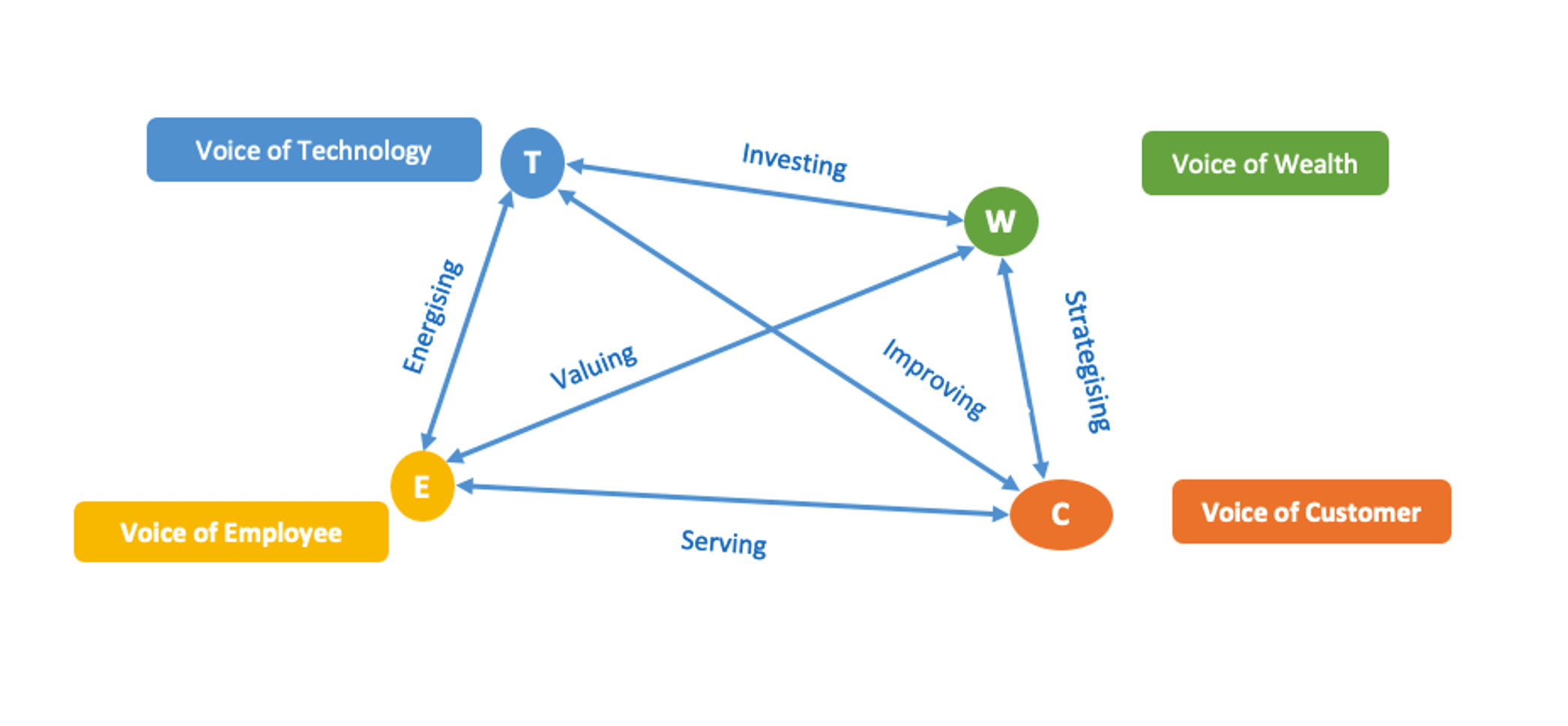
Voice of the Customer/Market (VOC): This represents the external universe, focusing on both the stated and unstated needs of the market. It asks: What is the customer really buying, and what are their latent anxieties or desires?.
Voice of the Investor/Wealth (VOW): This represents the financial world. It asks: What does the business investor want to trust? It anchors the premise of wealth generation, risk management, and the flow of financial capital.
Voice of Technology (VOT): This represents the internal reality of value creation and delivery. It encompasses your supply chain, R&D, and the operational excellence required to actually produce your product or service.
Voice of the Employee (VOE): This represents the human energy, motivations, behavioral practices, and psychological contracts of the people working within the organization. It requires leaders to understand what their associates truly need to feel valued and engaged.
(Note: There is also a foundational fifth voice—the Voice of the Ecology—which represents the larger social and environmental context the business operates within).
Mapping the Future: The Four Intersecting Zones
When you bring your team together to dialogue around a business plan, the magic happens by exploring how these four voices intersect. The Business Aligner maps these intersections into four distinct zones:
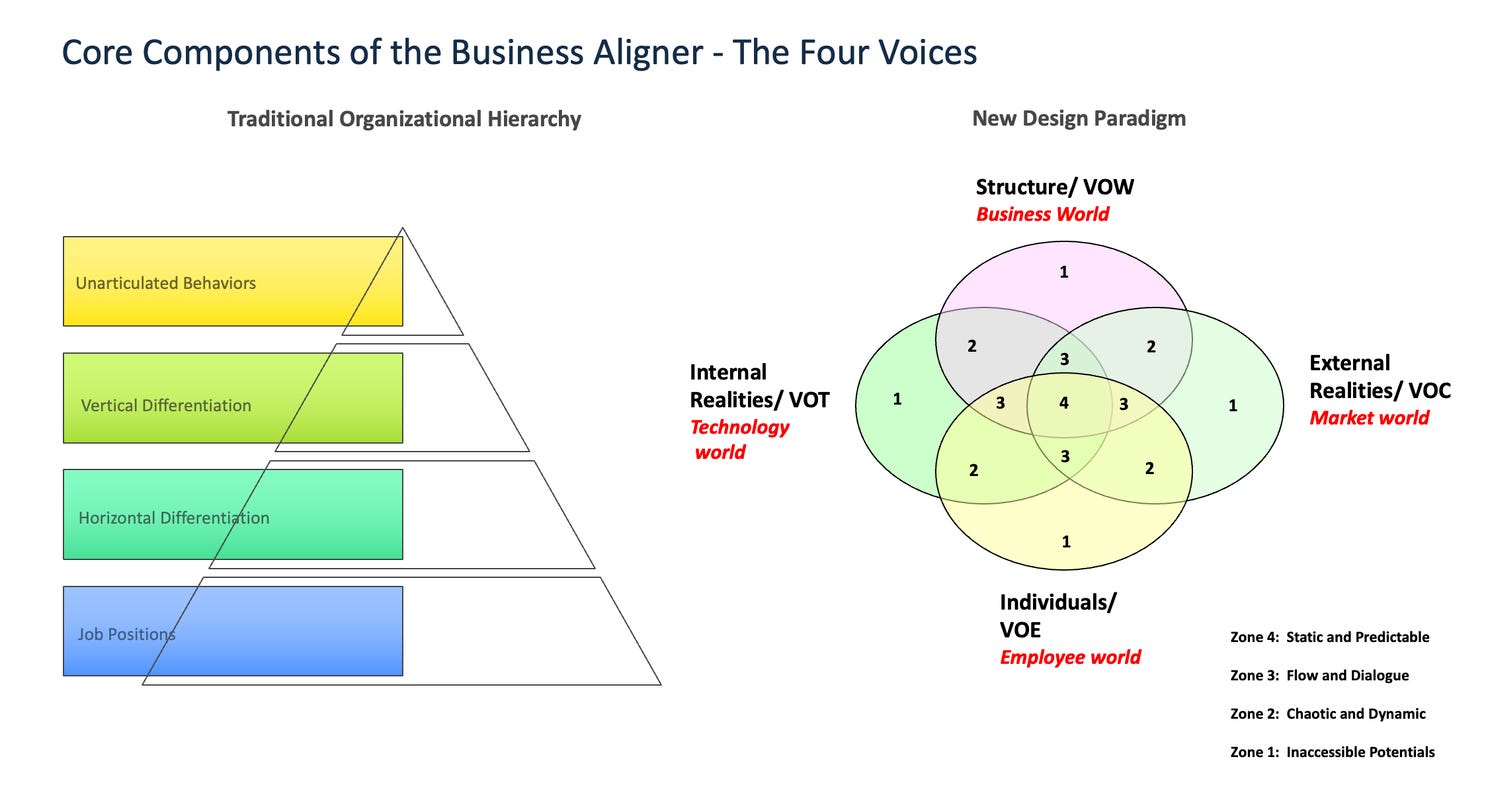
Zone 4: The Static and Predictable Core This is the center of the model where all four voices perfectly converge. The market needs your product, the technology can deliver it, the employees are capable of executing it, and the investors are happy with the returns. While this zone represents a stable flow of operations, starting a strategic conversation here is dangerous. It is a “red ocean” that is already highly static and predictable, and clinging to it can lead to stagnancy.
Zone 1: Inaccessible Potentials (The True Blue Ocean) Zone 1 represents a voice in total isolation. It is pure, untapped market potential, or a brand new technology that has no current market, funding, or team. Strategic conversations that lead to radical innovation must begin by visiting Zone 1. As the BA framework suggests, you cannot enhance Zone 4 without first exploring the uncharted territories of Zone 1.
Zone 2: Chaotic and Dynamic This is the convergence of only two voices. Think of a pre-revenue startup that has identified a profound customer need (VOC) and has the technology to solve it (VOT), but lacks the funding (VOW) and the right employees (VOE) to execute it. These are the “If-Then” scenarios. Deep strategic dialogue happens here by asking: If we pursue this alignment, then what infrastructure or investment do we need to build?.
Zone 3: Flow and Dialogue In Zone 3, three of the four voices intersect, but one is out of alignment. For instance, your market, investors, and employees are aligned, but you need to rapidly alter your technology (such as moving an in-person training program to a digital platform during a crisis). This zone requires strategic tweaks and continuous improvement to bridge the fragmented voice back into alignment.
How the Business Aligner Transforms Business Planning
When integrating the Business Aligner into your strategic planning sessions, the dialogue shifts dramatically:
From Fixing Pain to Active Foresight: Strategic meetings often focus on existing pain points, but acting on pain means you are already too late. The BA forces leaders to read early signals and map inaccessible potentials before they become emergencies.
Questioning the Status Quo: A manager maintains the status quo, but a leader questions it. The BA requires you to test your favorite, untested theories of management by actively stepping into the shoes (and physical locations, if mapped out in a workshop) of your investors, your employees, and your customers.
Building a Dynamic “If-Then” Narrative: Instead of rigid goal-setting, the BA uses the post-it-note synthesis of these four voices to create dynamic “if-then” statements. This helps teams co-create a coherent mental model and write multiple unfolding stories (a stretch possibility, a reasonable possibility, and a bad scenario) to navigate uncertainty.
By framing your business plan not as a static document, but as a continuous alignment of the Market, Wealth, Technology, and Employees, you ensure your organization maintains its Strategic Fitness. You move away from isolated, siloed targets and towards an inspired, co-created future where every role-holder understands how their work harmonizes with the whole.
If your strategic dialogues feel stuck in the past, it’s time to stop looking at the view, and start mapping the vista.