

In Sanskrit, verbs do not merely describe action.
They encode where the result of action lands.
This is where Parasmaipada (परस्मैपद) and Ātmanepada (आत्मनेपद) enter.
They are not “voices” like active/passive.
They are orientations of result.

1. The Structural Distinction
In the present tense (लट्), verbs take two sets of personal endings:
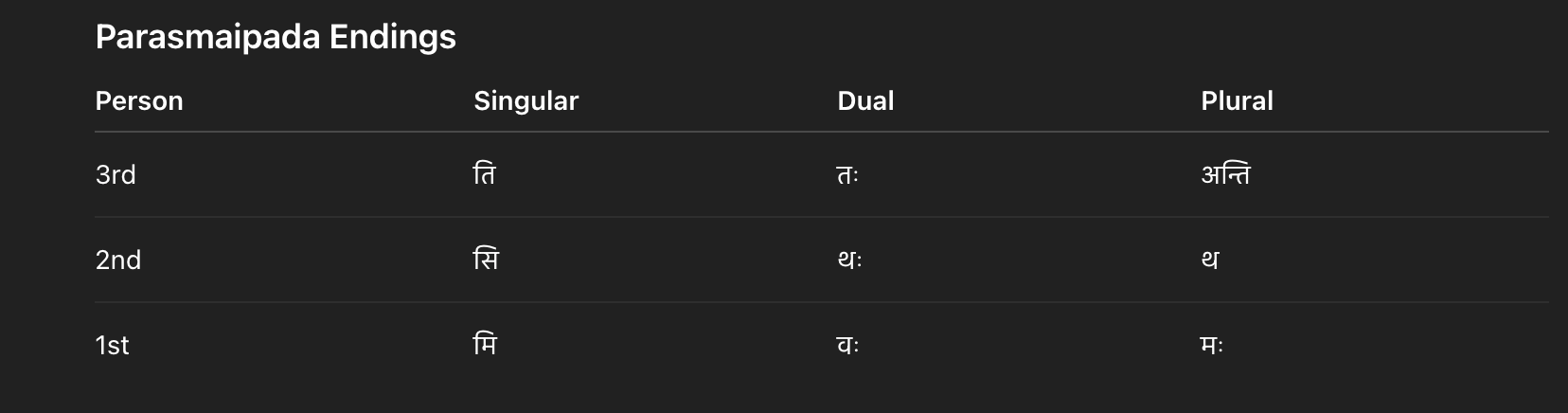
Example:
भवति — “he becomes”
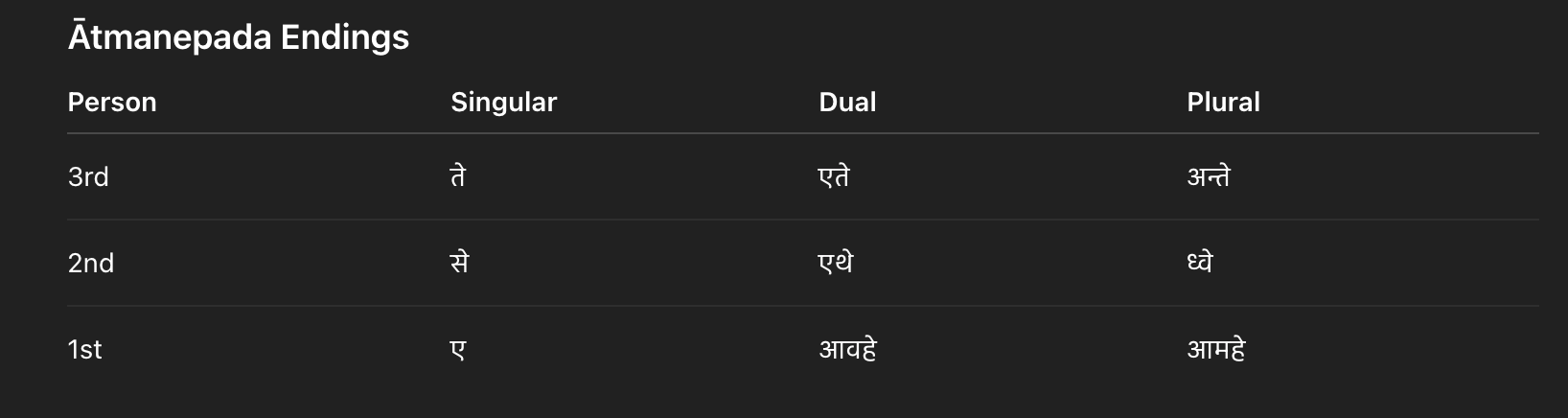
Example:
लभते — “he obtains (for himself)”
So far, this looks mechanical.
But grammar is never mechanical in Sanskrit.
2. The Principle Behind the Division
Traditional grammar explains:
Parasmaipada → the fruit of action goes to another (परस्मै).
Ātmanepada → the fruit of action goes to oneself (आत्मने).
This is not psychology.
It is semantic structure.
Let’s examine.
3. Parasmaipada — Action Directed Outward
Take the root दा (to give).
ददाति — he gives.
Who receives the fruit?
Someone else.
Take पच् (to cook).
पचति — he cooks.
The result is for others (family, guests, society).
The grammatical marking reflects this outward flow.
Parasmaipada verbs often describe:
Production
Communication
Transfer
Influence
The action moves outward from the agent.
4. Ātmanepada — Action Returning to the Agent
Take लभ् (to obtain).
लभते — he obtains.
The result comes back to the doer.
Take सीव् (to sew for oneself).
सीवते.
Take नन्द् (to rejoice).
नन्दते.
The fruit is internal.
Not externally transferred.
Ātmanepada verbs frequently express:
Experience
Internal states
Reflexive benefit
Transformation affecting the agent
The action curves back.
5. But It’s Not Always So Simple
Here is where shallow understanding collapses.
Some roots are:
P-only
Ā-only
Ubhayapada (both)
For example:
भू → भवति (Parasmaipada only)
लभ् → लभते (Ātmanepada only)
कृ → करोति / कुरुते (Ubhayapada in certain usages)
Why?
Because the nature of the root determines the pada.
You cannot “choose” based on your philosophical preference.
The root comes with its grammatical architecture.
This is why traditional grammars list the pada along with the root in the धातुपाठ.
6. Ubhayapada — A Deeper Insight
Some verbs take both endings.
Example:
कृ
करोति — he does (for another)
कुरुते — he does (for himself)
The same root shifts orientation.
This is profound.
Action is not inherently outward or inward.
It depends on intentional structure and semantic framing.
7. Not Passive Voice
Do not confuse Ātmanepada with passive.
Passive is formed differently:
भू + य → भवति → भूयते (passive)
Ātmanepada is not “being done.”
It is still active — but reflexively or self-oriented in result.
That distinction matters.
8. Philosophical Implication
Sanskrit grammar quietly encodes a law:
Every action has a direction of consequence.
Some actions:
Expand outward
Circulate socially
Transfer result
Others:
Mature inward
Transform the agent
Return to the source
The language structurally distinguishes.
That precision reflects a civilization deeply attentive to causality.
9. Practical Learning Strategy
If you are serious about mastery, do this:
When memorizing a root, memorize its pada.
Never conjugate mechanically.
Ask: “Where does the fruit of this action land?”
Track ubhayapada roots separately.
Observe shifts in meaning when the pada changes.
This is not rote grammar.
It is semantic architecture.
10. Summary
Parasmaipada → result goes outward.
Ātmanepada → result returns to the agent.
Some roots are fixed.
Some are dual.
This is not optional — it is built into the dhātu system.
Sanskrit does not merely describe action.
It maps consequence.
And once you see that, conjugation stops being mechanical.
It becomes structural insight.