
The Founder’s Guide to Preparing for Fundraise and Diligence
Raising capital is not just about readiness. It’s about resonance.

1. The Real Question Isn’t “Are You Fundable?” — It’s “Are You Ready?”
A founder I recently worked with, Meera, built a beautiful SaaS product with early traction and a growing client base.
When she began her Series A process, investors liked the numbers — but diligence got stuck.
Not because the business wasn’t sound, but because the story and the system weren’t speaking the same language.
One spreadsheet said “growth.”
Another suggested “burn.”
HR policies were in Google Drive; contracts were on email threads; MIS reports arrived 10 days after month-end.
It wasn’t a lack of capability — it was a lack of coherence.

2. Fundraising Is a Mirror, Not a Stage
Most founders approach fundraising as performance.
But the best ones treat it as reflection.
A good diligence process doesn’t just expose gaps — it teaches you what needs to mature before scale.
Think of it this way: diligence is the investor’s way of asking,
“Can your systems carry the weight of the capital you’re asking for?”
The more coherent your answers — across finance, leadership, and culture — the stronger your negotiating position.
3. The Four Dimensions of Investor Readiness
Assess founder readiness not by pitch decks, but by alignment across four lenses:
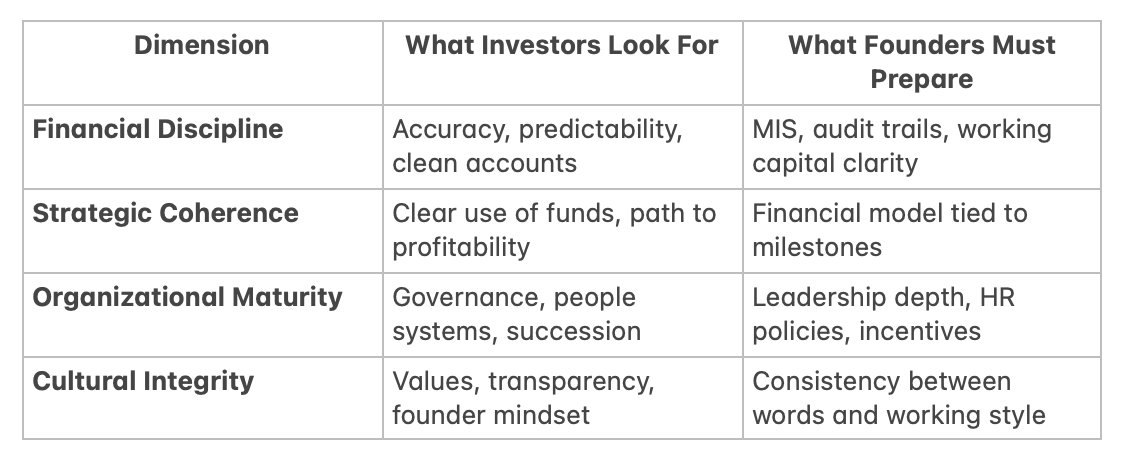
When all four align, investors see not just numbers — but signal.
4. The Diligence Landscape Has Changed
Today’s investors — especially post-2023 — are no longer chasing momentum; they’re seeking evidence of discipline.
Key trends shaping due diligence today:
✅ Integrated Diligence: Investors assess financial, legal, and ESG aspects together.
✅ Sustainability Metrics: BRSR-linked disclosures and ESG readiness are becoming standard in India.
✅ Data Rooms 2.0: Investors expect real-time access to digital dashboards — not emailed PDFs.
✅ People & Culture Scans: Tools like EUM-O (Existential Universe Mapper) are now used to assess leadership alignment.
In short: diligence is evolving from a compliance check to a capability audit.
5. How to Prepare Like a Pro
If you’re planning to raise in the next 6–12 months, here’s a practical roadmap I share with my clients:
Step 1: Build a Financial Story, Not Just a Model
Your financial model should connect metrics to meaning.
Start with 3–4 key KPIs (ARR growth, CAC payback, gross margin, burn multiple).
Create 3 scenarios: base, stretch, and conservative.
Map capital use to milestones, not time periods.
Step 2: Create a Clean Data Room
Investors love hygiene.
Structure folders: Finance, Legal, Governance, People, ESG.
Standardize filenames, timestamps, and access controls.
Add a one-page explainer on “How to Read This Room.”
Step 3: Run a Mock Diligence
Simulate the process before the investor does.
Have an external advisor review gaps.
Test whether you can answer “why” as confidently as “what.”
Step 4: Prepare Your Leadership Narrative
Investors invest in teams, not ledgers.
Anticipate questions about culture, succession, and leadership bandwidth.
Align your co-founders on messaging around vision, valuation, and exit.
Step 5: Align Finance with Purpose
The most compelling pitch decks blend financial foresight with founder clarity.
Why now?
Why this market?
Why this team?
Why this use of capital?
6. What Diligence Reveals About You
When investors look through your data room, they’re not just checking facts — they’re reading patterns:
Are you transparent or defensive?
Do your numbers tell a consistent story?
Does your leadership team respond with coherence or chaos?
Every spreadsheet is a reflection of your maturity.
Numbers are language; systems are culture.
7. The Founder’s Advantage: Coherence
In the end, diligence doesn’t reward perfection — it rewards coherence.
When your vision, numbers, and systems tell the same story, you signal credibility and trust.
As one investor told me recently:
“We back founders who understand that money amplifies what already exists — clarity or confusion.”
So, before you raise capital, raise your alignment.
That’s the real diligence that matters.
👉 Subscribe to Artha Viveka for more essays on finance, leadership, and the human side of scale.